

Naïssam Jalal
Interview
A Politics of Listening
It is one of those Paris mornings when the rain never quite decides to fall or stop. Outside the Aubervilliers–Quatre Chemins metro station, men gather to smoke, sell loose cigarettes, talk. Almost every face is male. The café where we meet feels less like a café than a salon where decisions get made — domestic, political, financial — over glasses of mint tea that outlast the conversation itself. For most of the hour, we are the only two women in the room.
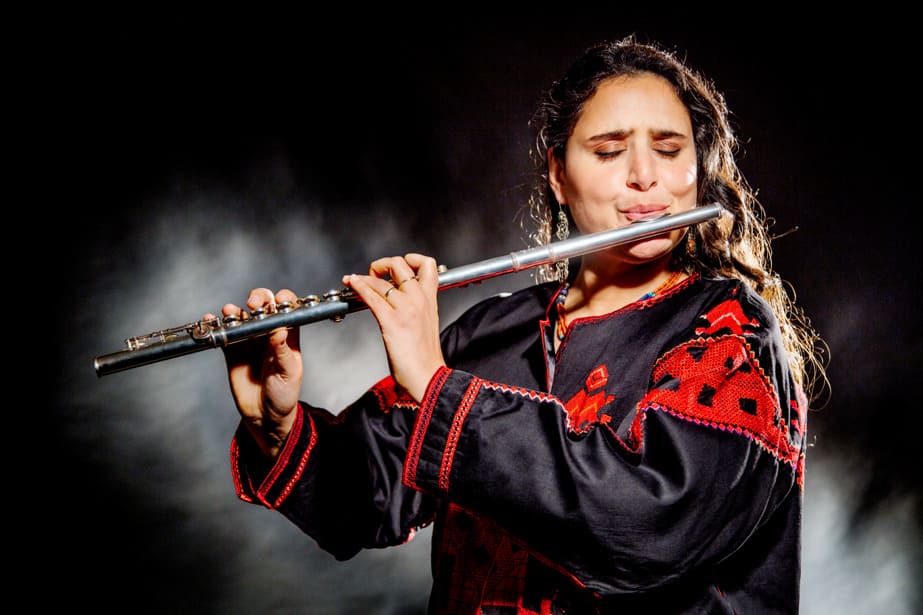
Naïssam Jalal arrives by bicycle, soaked. She has rehearsal soon. The following evening she is about to premiere a new repertoire at 38Riv Jazz Club, an intimate room set inside a 12th-century vaulted cellar in the Marais. The music would later become Landscapes of Eternity, an album born from months she spent travelling alone through North India, recorded at Studio La Buissonne and released in the spring of 2026.
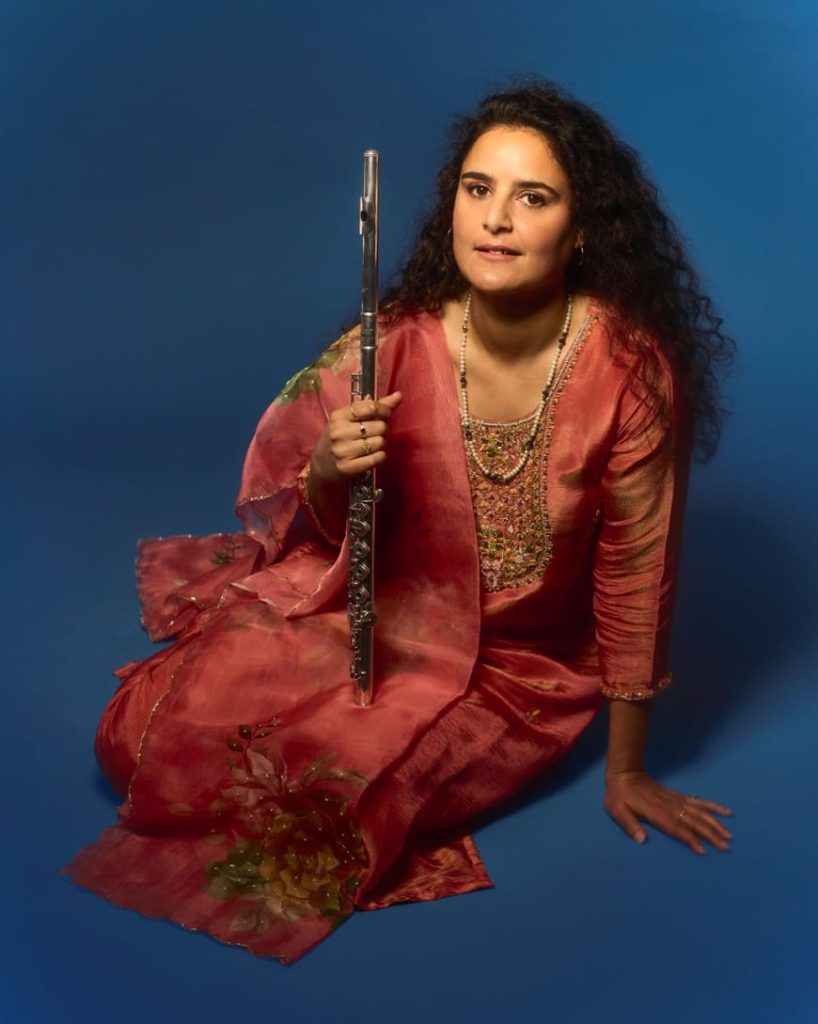
Born in Paris to Syrian parents, Jalal trained as a classical flautist from the age of six. At nineteen she left for Damascus to study the ney, then Cairo, where she learned under violinist Abdu Dagher and pianist Fathy Salama. She has since led four groups, released a long line of albums, scored films, and been named Chevalière de l’ Ordre des Arts et des Lettres. None of that, however, is where she wants to start.
What follows is not a chronology, but the path the conversation took.
In&OutJAZZ Magazine: Your music seems to find a particularly attentive audience in Spain. Why do you think that is?
Naïssam Jalal: I feel it, honestly. Through concerts, through streaming, through Instagram. When I played in Málaga, people shouted olé while I was playing. It felt completely natural — no distance at all. I think there’s a shared history around the Mediterranean, of wind instruments finding their way into flamenco. Maybe people hear something familiar in the flute.
You move between Arabic maqam, European classical training, Hindustani music, West African tradition, improvisation. And yet you resist being called an expert in any of them.
Because I’m not. I have very little knowledge, actually. At the conservatoire I learned to read and write music. But I never felt I was making music there — I was just reading notes off a page. I went to Egypt and Syria to study Arabic music for three years, but Arabic music is enormous, and I was young, more interested in finding an identity than in learning scales. So mostly what I did was listen. Listen, listen, listen. The music enters you that way. You don’t learn it — you absorb it. Like a sponge in water.
The only real exception is Hindustani music. For the past five years I’ve had an actual teacher, actual homework, actual discipline. But even there, I’m not trying to become an Indian classical musician. I know I never will be, and I don’t want to be.
And composition?
You don’t need to study composition to compose. You need to listen to what’s happening in your own heart and be honest enough to put it into sound. That’s how I compose. That’s how I improvise. The vocabularies I use come from many cultures — but they’re vocabularies, not ownership.
West African music seems to run especially deep in you.
I grew up around it. My neighbourhood was full of families from Mali and Senegal — I heard griot music and Mandingue traditions coming through the windows. At home, it was Umm Kulthum and Fairuz. As a child I actually told my parents their music sounded wrong — because at the conservatoire I’d learned music is made of tones and semitones. Arabic music isn’t. It has notes between the notes. Microtones. It took me years to understand that tempered music isn’t nature — it’s a European convention a few centuries old. Nature is microtonal. The natural world is full of frequencies that do not fit neatly into tempered systems. The conservatoire gave me a system. It also, for a long time, stopped me from hearing the music that already belonged to me.
You’ve said improvisation changed everything. What happened?
I was seventeen, playing at an exhibition of my father’s paintings — he’s a painter. A double bass player was there, and he asked me to improvise with him. I said I couldn’t. I could play anything written down, but not that. He didn’t let it go. Finally he said: take these five notes, only these. I played for twenty minutes and couldn’t stop. When I finally did, I felt like a weight had left my body. Something physical. That was it.
Did you already have control of the instrument at that age?
Yes I did. At some point you know the instrument well enough that you stop needing to control it.
You once went to Syria in search of your identity. Now you describe identity as something constructed. What shifted?
I was born in France, I was French, and French society looked at me as a stranger anyway. So I thought — if they insist I’m Arab, I should at least know what that means. So I went. I learned Arabic in Cairo, not at home — my parents wanted me integrated into a society that, even so, treats you as foreign whether you speak their language or not. I lived in Syria, Egypt, later Lebanon, between Beirut and Paris for seven years. I married a Palestinian man for fourteen years — we separated recently. I chose Arabic as the language of my home. That was a choice, not something imposed on me.
So identity is never fixed?
No. But it’s not free either. However much we build ourselves, other people’s eyes are always part of the construction — eyes already full of prejudice, deciding who you are before you speak. It’s a very narrow path.
I don’t remember exactly when I understood I was Arab. But I remember being afraid, as a child, of young Arab men in the street — avoiding walking near them. That’s what I’d been taught by the images around me. Then one day I understood: they are like me. Or I’m like them. After that I stopped avoiding them.
Which of those belongings feels most alive in you now?
West Africa, deeply — since childhood, I identified with the Malian and Senegalese families around me, and with people from Algeria and Morocco, because we were all treated the same way — as immigrants, as people from formerly colonised societies. There was no Syrian community where I grew up, so those were the people I recognised myself in.
India is different. It came through music, and it also became a mirror — because so much of what I encountered there, caste, hierarchy, the place given to women, is often far from what I believe. I’ve loved Egyptian society, Syrian society, Lebanese and Palestinian society, in a way I’ve never loved Indian society, even while its music holds enormous importance for me. Loving a place has never meant thinking it’s perfect — not there, not anywhere. That includes what I think about how much freedom women actually have across the Arab world, which is so very little, whatever the country.
You’ve said you never studied jazz, and didn’t even like it as a young woman.
I hated it, actually. In France, jazz is the music the white bourgeoisie listens to. That’s how I saw it growing up. What I loved was funk, hip-hop, Malian music, Arabic music. Then, on my first tour in Mali, a friend put on Coltrane’s “Olé” for twenty minutes. By the end I was somewhere else entirely. I wanted to know more. Since then I’ve listened obsessively to John Coltrane, Alice Coltrane, Pharoah Sanders, Randy Weston, Archie Shepp — musicians who inherited that tradition and kept pushing it further. Bill Evans is beautiful — important music. But he isn’t burning the way they are. He wasn’t engaged politically the way they were.
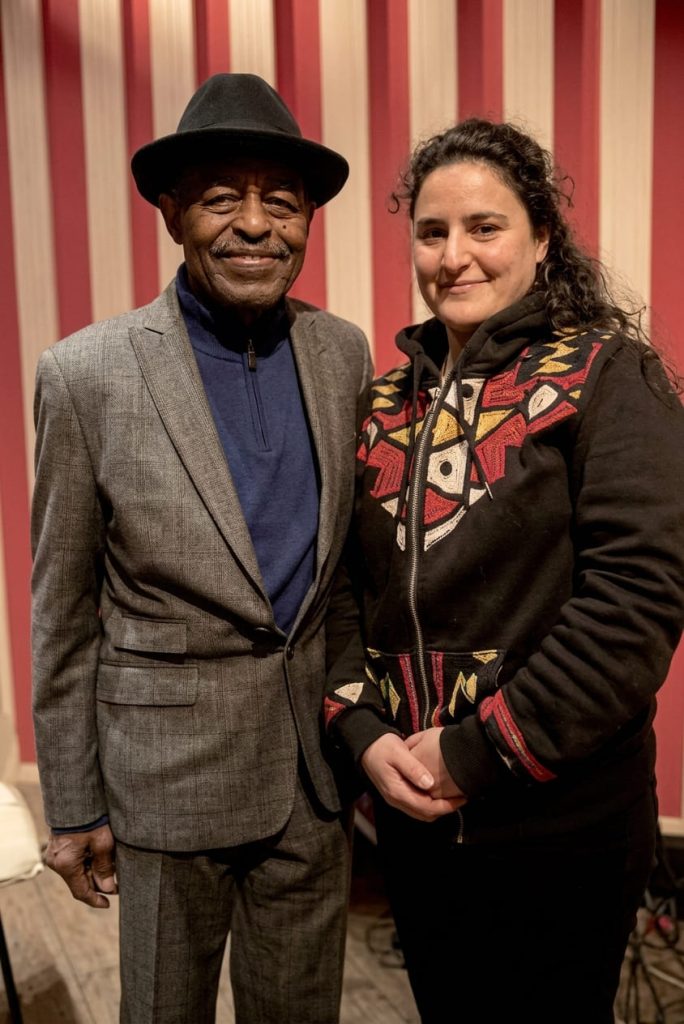
How was working with Archie Shepp?
Amazing. Sweet, humble — a giant who behaves like the gentlest man in the room. I composed a melody for him, and he told me it reminded him of Coltrane, and that there was a lot of sadness in it. I didn’t feel it as sadness. For me it was spiritual — closer to gospel than to grief. But that’s how he heard it, and I loved that he heard something at all.
And yet you insist your own music isn’t jazz.
It isn’t, no. There are two things people mean by “jazz.” One is the US African American heritage and legacy — a tradition, like griot music, like Hindustani music, just younger. I don’t play that. I have no claim to it. The other definition is simply music with improvisation, drums and double bass. By that definition, sure, I do jazz. But improvisation isn’t jazz’s invention — it’s at the centre of Hindustani music, of Arabic classical music, of West African tradition. Calling improvisation “jazz” erases all of that. What connects me to jazz, really, is just the drums and the bass.
And here’s the thing: since I live in a country that treats me as an Arab woman first, I’m expected to play the music of my ancestors, not to compose, not to imagine, not to be seen as a creative person — just as someone following a tradition. So claiming “I’m a jazz musician,” even though I’m technically not, becomes a political act. It says: recognise me as a creative composer, not as folklore. Because right now in Europe, “jazz” has come to mean creative music. Refusing the label is a political act too — it says I won’t be filed under “world music” just because I’m an Arab woman.
It’s still complicated. There are white musicians playing music that’s really pop, commercial, nothing close to jazz — and they get invited to festivals I’m turned away from, told I’m “not playing jazz.” They aren’t either. But nobody tells them that.
Before you found improvisation, you wanted to be a politician.
I wanted to change the world, to bring justice. When I first improvised, I understood I’d play music instead — but the impulse never left. My first band, Rhythms of Resistance, came directly out of that: against capitalism, against war, against colonization, for freedom in Syria, in Palestine. I was deeply involved in the Syrian opposition here in France, trying to make people understand what was happening — the killings, the torture, the chemical weapons — while, for years, nothing changed.
When Syria enters the conversation, it changes. She slows down, choosing her words carefully.
People died and died and died. I felt powerless. We have no real power in front of people willing to do what they do. Animals don’t kill for pleasure. We do.
In Barcelona, people have taken to the streets over the war in a way I haven’t seen elsewhere. In Italy, a general strike stopped the whole country last year. They pulled an Israeli team out of a major cycling race. So sometimes there’s a little power. But it’s so little against everything happening — and I find it strange that so few places still try to fight for peace and justice.
I think a lot about how France frames itself as the country that will finally “recognise” a Palestinian state, after allowing years of destruction to happen first. Recognise which country, at this point? It’s hard, these days, to call ourselves a civilised people.
That’s why, at some point, I decided I should only care for care. The only thing I can really do — the only thing left in my hands — is offer some beauty, some healing, through music. Not hope, exactly. Just that. It’s the only way I still have any impact on this world.
