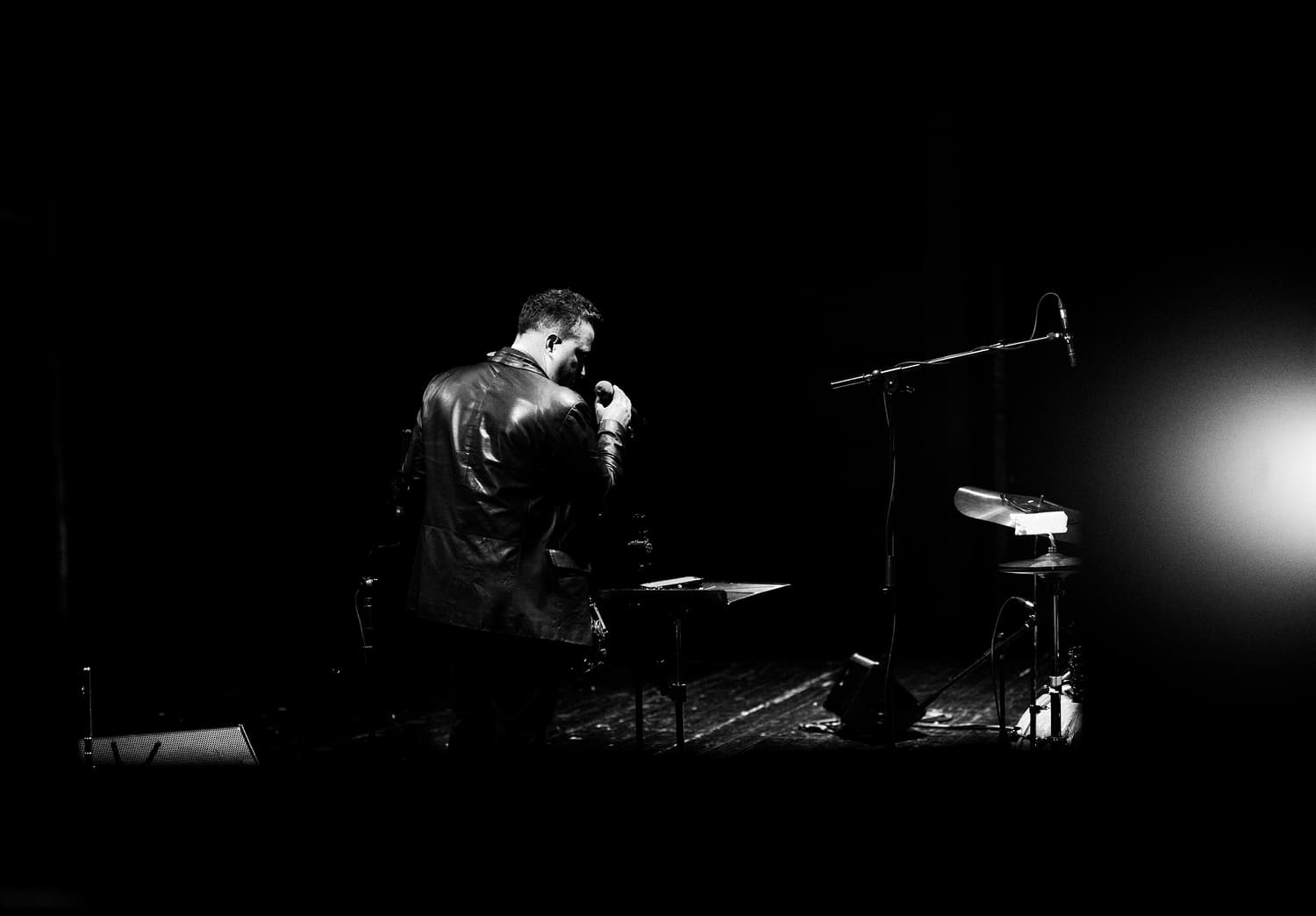
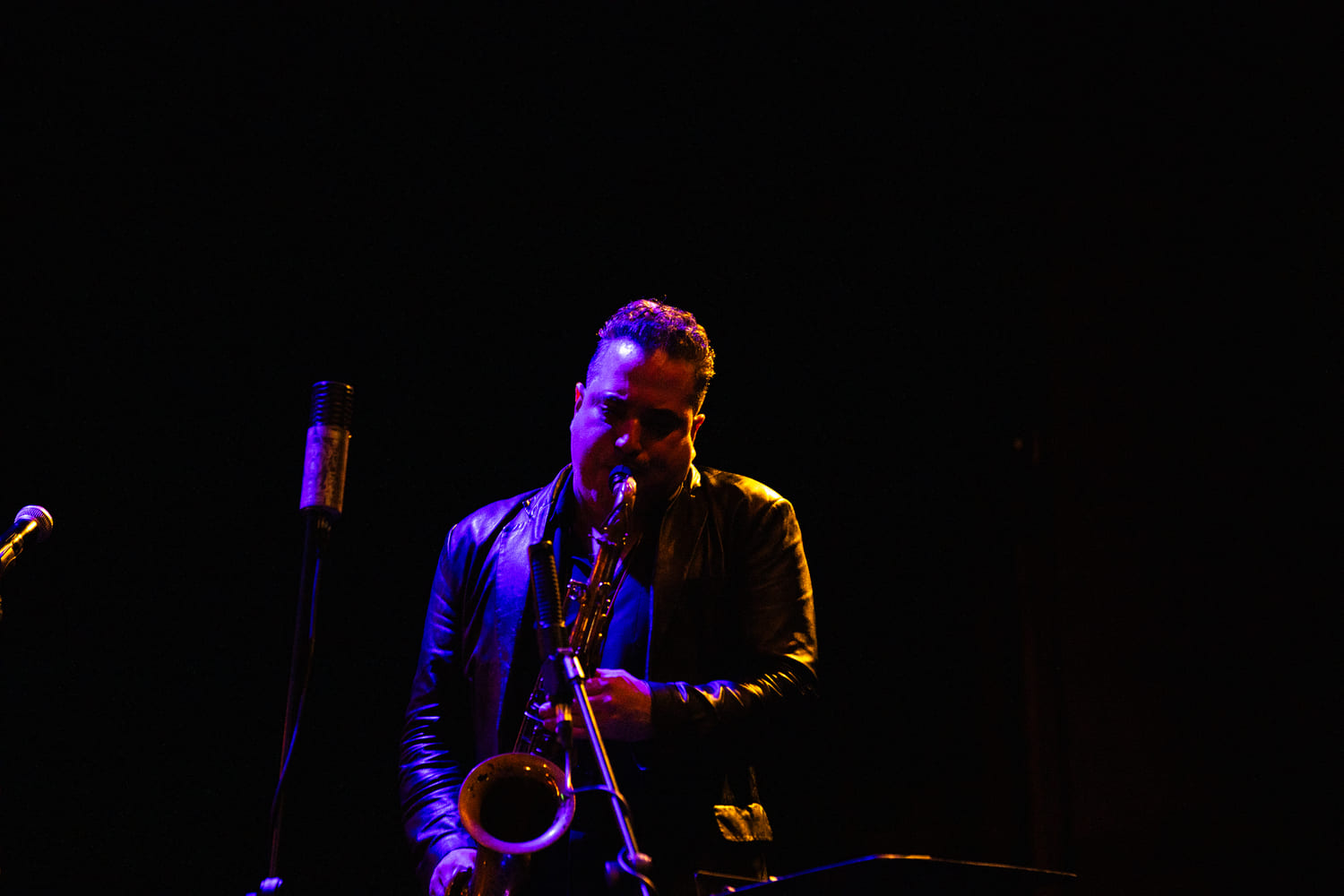
Hery Paz
Interview
If it’s true that a creative soul must always look for new apertures, then Cuban-born, NY-based saxophonist Hery Paz embodies the paragon representation of what an artist should be – a restless and tireless figure, who is always in pursuit of a fresh vision. No work of his sounds like the one before it, and with every note, he carries the listener into a deep dark forest of tone, mood and utmost spontaneity. What has always set Paz apart from many of his contemporaries as well, was how true his pursuit feels. Beyond the idea of a professional musician, who may approach things at least partially from a transactional point of view, Paz’ creations often feel like personal exercises in making something beautiful as an end in and of itself.
Now, in the wake of his excellent album from last year, the all-encompassing multimedia experience of Fisuras, In&OutJazz sat down with the brilliant composer and improviser, to try and procure at least a partial portrait of how he came to become one of the most exciting and exploratory forces within the avant-garde.
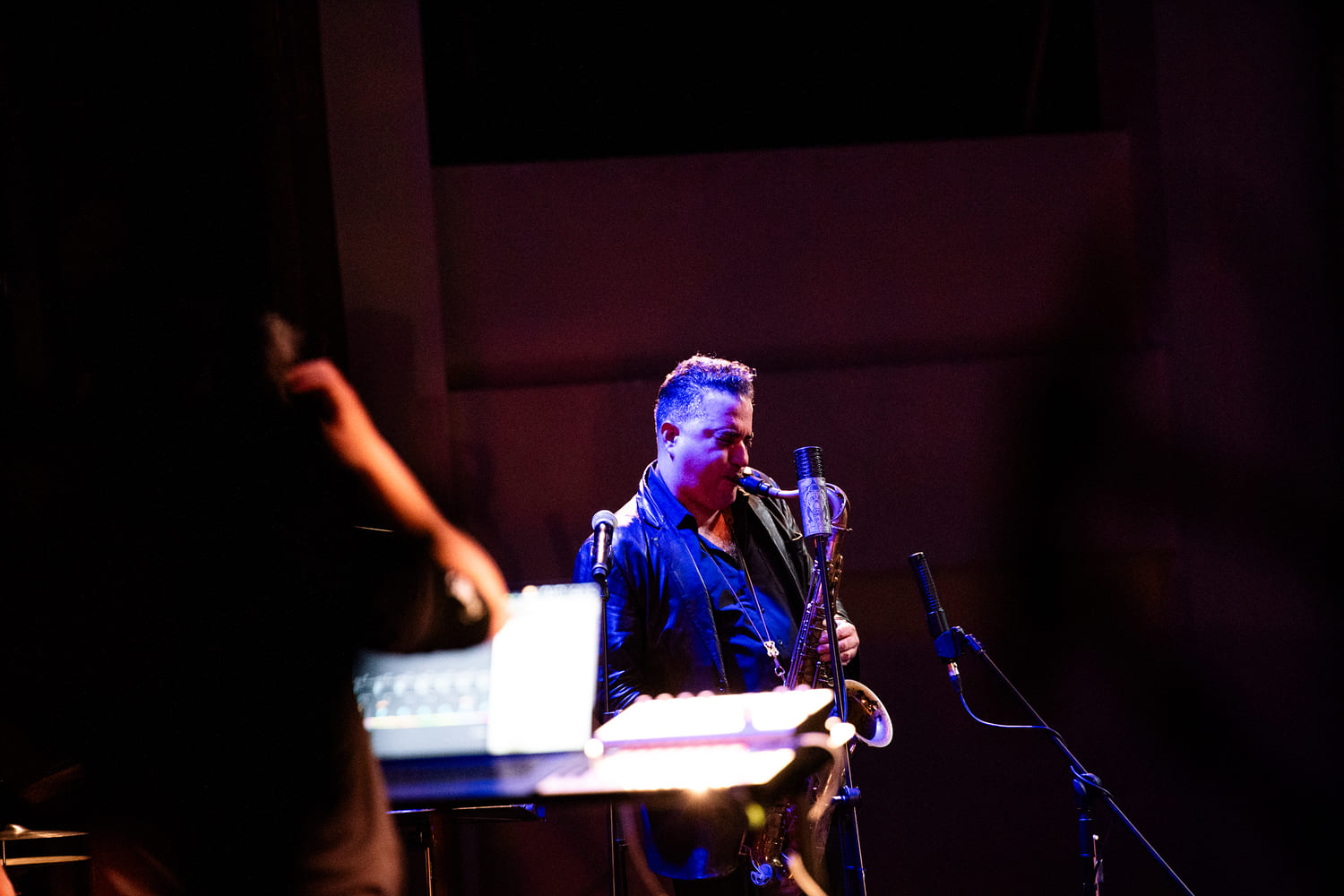
In&OutJAZZ Magazine: I didn’t realize that your very first instrument was the guitar.
Hery Paz: My father is a traditional musician. This is what he did for a living. My relationship with music started when I was really young. There was music at home, my father’s friends would be over. My first instrument at home was the guitar. My dad tried to give me lessons, and that did not work out. We realized early on that if I was going to be a musician, I needed another teacher, not my father. It didn’t translate very well between the two of us. But I had my guitar, which was a Soviet guitar. They were pretty terrible guitars, they were travelling guitars, and you could take the neck apart. At some point, a really good luthier in my hometown put a cedar top to the guitar and fixed the arm in such a way that it was way better. I heard my father give lesson, and I was always trying to figure songs out on my own. By the time I was nine, I told my dad, listen, I want to do this seriously.
And then I joined the conservatory on classical clarinet, and then flute the next year. So, this is how my relationship with the woodwinds started. I wanted to play trumpet, but my dad didn’t allow me. He was a trumpet player, and he told me – I’m not going to do this to you. One day in the future, you’re going to agree with me that it’s not the easiest of instruments.
So, then I started playing clarinet and flute, and did six years of conservatory in Cuba, before I migrated over to the U.S. My mother won a visa lottery. And with the help of some friends from abroad, they put the money together to get us out of the island. And then I got to the U.S. in 2001.
Clarinet and flute were still my bread and butter for a while, until in college, a professor gave me a saxophone. And that changed my life. And my trajectory became a jazz one. The saxophone came into my life when I was 21 years old, and it came to stay.
So when did you shift from traditional jazz modalities into free improvisation and the avant-garde?
I’ve always been an improviser within the context that I lived. My grandfather was a bit of a mechanical engineer and inventor, and he was an improviser as well, even though he was not a musician.
But I think it’s more of an attitude and a way of living, whether it includes the arts or not.
Improvisation-wise, part of how I was exposed to it early on had to do with Cuban music, where trumpet, trombone, flute and tres players improvise within the context of the music. It was always there. And I always had a knack for it. And I got into the conservatory and the first real argument about improvisation that I had was the fact that I wanted to play my own cadenzas (laughs).
Also, a lot of classical repertoire in Cuba that I had access to, especially on the flute, was Bach. And Baroque music always had space for improvisation, all these themes with different variations. The relationship, I think, is a lot closer to what jazz is. I think that’s also how my harmonic ear started developing.
When did you start moving away from academic structures and integrating yourself into New York’s playing scene?
I’ve been in New York now for 11 years. After I graduated. I did a Master’s Program at the New England Conservatory in Boston. I had the chance to study with some amazing people. And it’s the only program that has a contemporary improvisation department, apart from a jazz department. So you might get some great sitar player from the Middle East, and then you end up in an ensemble playing improvised music in whatever context you could put together. It was very eclectic.
And by the time I got there, I was ready to stretch and explore. So that got me started in understanding where I wanted to be and what I wanted to pursue musically. And by the time I got to New York, it all consolidated here in the scene.
The first year in New York is a little disorienting. You’re checking everything out. You’re doing all sorts of sessions.
But then there’s a certain gravity where things start to align. You start to meet people that have similar ways to looking at music. And you start gravitating towards those people and playing with them.
You also represent a through-line between the mainstream and the avant-garde. You’re playing flute on Broadway with the Buena Vista Social Club musical.
It is interesting how these things happen. The musical was partly put together by one of the original members of Buena Vista, Juan de Marcos González. So when I got the call, I thought it was a prank. I even hung up on him at first (laughs).
I mean, I play improvised music. Almost nobody in New York knew that I was a flute player. Some of my own things, but as a sideman, I didn’t play flute with anybody in New York. But González got in touch with enough Cuban saxophone players to know that the flute and clarinet parts in the show were difficult. And everyone told him that if you need someone to play flute the way that you need it, there’s a guy in New York that you should call. And that’s how I got the call. Funny enough, he had checked all the videos of me playing free music. And that was that!
I actually went on tour with him and the Afro-Cuban All-Star Band to SF Jazz and we played a stint there. I played mostly flute, soprano and tenor with him. It was a really nice way of coming back to my roots.
The musical also allows you to play the way that you play, because they know that the background that I have is within the context of what I play. And there was no flute on the original record, so I got to make my own blueprint as well. Every night, I take a different solo on that tune, and I take it as far as I like.
I wanted to ask you about Fred Hersch, because I know you have a special relationship.
Fred used to teach at New England Conservatory. That’s how I met him. He’d come to do this masterclass, and usually the people signing up for his masterclass are piano players. But I said – I want to play for Fred, and I want to play with a saxophone trio, not piano.
We connected right away. He had great things to say. And he was helpful and very giving. I ended up playing an ensemble of his music at some point. And I connected to some albums of his, he’d made a record with Ralph Alessi and Tony Malaby. It was one of the first times I’d ever heard Tony playing. Tony then also became an influential figure.
I love Fred’s music, and I have loved always Fred’s approach to playing. He is always open to you being different, and bringing non-traditional ideas into playing.
I came to him once, and told him that it’s really hard for me to play Monk’s music on the saxophone. And Fred was the first person to tell me about Steve Lacy, and how he codified how to play Monk on a saxophone. And we had a long conversation about it and coming to the fact Fred taught at that university, at NEC, at the New England Conservatory for a very long time.
Another pillar for me from the school was Joe Morris. He taught for a long time, and he’d recruited me while playing in the Bob Moses Ensemble. We have had a working relationship together since. I’ve recorded albums with Joe, I’ve played with Joe and I’m always learning from Joe. He’s a true improviser, an American original.
But through all these teachers and influences, you managed to develop your own voice. When I listen to your music, I know it’s you. You don’t sound like Ornette or Ayler, you sound like Hery Paz.
Thank you. I think getting to the school as an older person than most students helped with it. I had real focus and my own ideas of how to carve my path. I also had to get as far back from my roots, in order to return to them with a completely different view.
You mentioned that your father is a painter as well. And on Fisuras, you deployed everything – music, poetry, visuals. You walk this postmodern path very well. Which is a very difficult thing to do, and most artists who pursue several disciplines at once end up being mediocre in all of them.
The way I can put it is this – my father is a painter and a musician, so I never questioned the idea that you could do all these things, and they could complement each other in some ways. But, verbally at least, my grandfather was more inspirational. He was a great mind. My grandfather was an inventor, who studied electrical engineering late in life. He made tube amplifiers, guitar strings, bass strings. And he had this little shop in the back of his house, where we lived, so I got to spend a lot of time with him. I was the only grandkid that was allowed to spend time in his shop. And he would give me materials to make my own toys, and we had long conversations, and for many years, I was sort of like his assistant at the shop.
He taught me something early on that to this day is of utmost importance to me. He said that modern society is built around the idea of the specialist, about having a certain amount of hours dedicated to one craft, and being extremely good at it, but being ignorant of everything else. But he also said that, in some ways, this is a way for society to control you as well.
So he told me, never have any hobbies. Do whatever you do, but do it seriously. And so I always think of the influence one thing has on the other.
Thank you, Hery! As a closer, give us your favourite saxophonists. No order, as an instinct, the first that come to mind.
One of the most influential figures in my life for the past six years has been Evan Parker. What he has developed over time is beautiful.
I’ll also name Roscoe Mitchell and Charles Gayle. And then Albert Ayler and Dexter Gordon. Gordon playing ballads will always keep me up at night.
And of course, I could never live without John Coltrane. Interstellar Space will always be one of the most beautiful things I’ve ever heard.